The Duolingo Effect
Why Animated Mascots Drive 40% More App Engagement (And How to Create Yours)
Most apps look the same. Same layouts, same stock illustrations, same forgettable UI. Then there's Duolingo — an app that turned a green owl into a cultural phenomenon, drove 4.5x growth in daily active users, and crossed $1 billion in annual revenue.
The secret wasn't better language lessons. It was Duo, their animated mascot.
This article breaks down what we call "The Duolingo Effect" — the measurable impact that an animated brand mascot has on engagement, retention, and revenue — and shows how any app can replicate it.

What Is the Duolingo Effect?
The Duolingo Effect is the outsized boost in user engagement, brand recall, and organic growth that happens when an app uses an animated mascot as its core brand personality.
It's named after Duolingo's owl mascot, Duo, which transformed a language-learning app into one of the most recognizable brands on the internet. But the pattern extends far beyond Duolingo — Discord, Mailchimp, GitHub, and Reddit all use mascots to similar effect.
The data is clear: apps with animated mascots see measurably higher engagement, retention, and revenue compared to those without. (A mascot is the emotional lever in the broader app engagement playbook.)
The Numbers Behind the Duolingo Effect
Duolingo's Mascot-Driven Growth
Duolingo is the most dramatic example of mascot-driven growth in the app world. Here are the numbers:
- 4.5x increase in daily active users attributed to their mascot-driven brand strategy1
- 52.7 million daily active users as of Q4 2025, up 30% year over year2
- $1.04 billion in revenue in 2025, up 39% year over year2
- 80% of users come from organic channels — word of mouth, viral content, and brand campaigns featuring Duo3
- 133.1 million monthly active users, up 14% year over year2
The mascot isn't a side feature. It's the growth engine.
The "Death of Duo" Campaign: Mascot as Growth Lever
In February 2025, Duolingo ran one of the most successful marketing campaigns in app history — they "killed" their mascot. Duo appeared with X'd-out eyes, reportedly hit by a Tesla Cybertruck. Here's what happened:
- 1.7 billion social impressions in two weeks4
- Android downloads up 38%, with a 25% increase in Android users5
- Highest single-day iOS downloads of the entire year5
- 25,560% spike in brand mentions on February 11, 20254
- 45,000+ uses of #ripduo hashtag4
- More new daily active users in Q1 2025 than any single quarter in company history5
A "Bring Back Duo" website challenged users to collectively earn 50 billion XP through language practice. They hit 50.9 billion XP across 15 countries. The mascot turned a marketing stunt into the biggest user engagement event in the company's history.
Industry-Wide Research: Mascots Move the Needle
It's not just Duolingo. Research backs up the mascot effect across industries:
- 37% more likely to increase market share — campaigns featuring mascots vs. those without6
- 34.1% higher profit from long-term mascot campaigns7
- 41% stronger emotional connection between consumers and brands using mascots7
- 50% longer dwell time on ads featuring mascots, with 25% higher spontaneous brand recall8
- 30% more likely to grow profit gains for mascot-driven campaigns6
- 16% more likely to trust a brand when mascot characters make direct eye contact9
Mascot Campaign Advantage
% improvement over non-mascot campaigns
For a complete breakdown of mascot strategy, design principles, and more iconic examples, see the Brand Mascot Guide. For original data on how rare this is in practice — only 4% of the Top 100 free US iOS apps actually ship a mascot — see our State of App Mascots 2026 audit.
Why Mascots Work: The Psychology
1. Parasocial Relationships
Users form one-sided emotional bonds with mascots the same way they do with fictional characters. Duo isn't just an icon — it's a personality that users feel connected to. This emotional attachment drives daily engagement without push notifications or gamification tricks.
2. Brand Recall
A distinctive animated character is easier to remember than a logo or wordmark. The 25% improvement in spontaneous brand recall from mascot campaigns means users think of your app first — when browsing app stores, recommending tools to friends, or seeing social content.
3. Shareable Moments
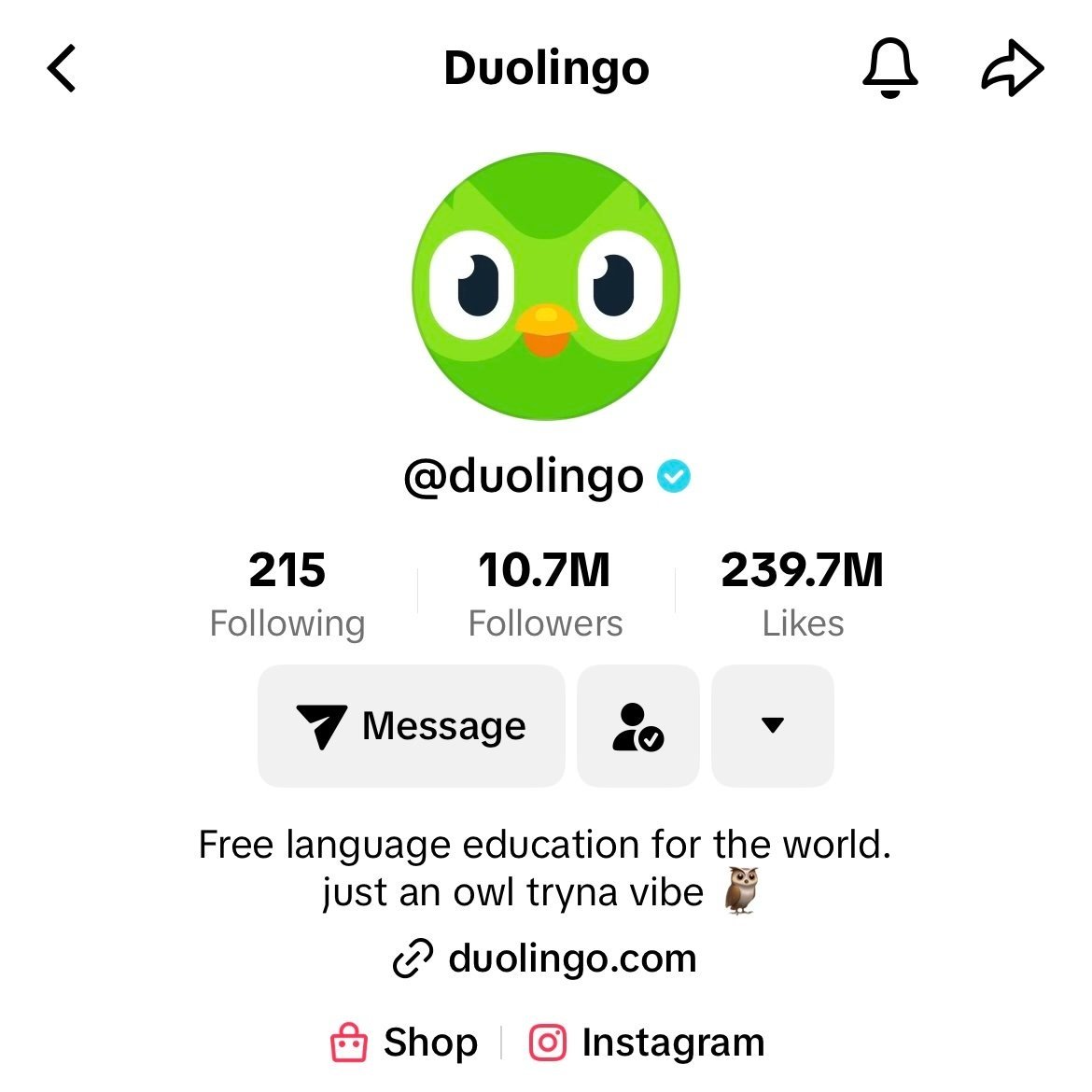
Mascots create content that people want to share. Duolingo's TikTok account (millions of followers) is built entirely around Duo's "personality." Discord's Wumpus generates more fan art than most indie games. When your mascot becomes a character people talk about, you get organic reach no ad budget can match.
4. Emotional UI
Mascots transform functional interactions into emotional moments. Mailchimp's Freddie gives a high-five animation when you send your first email campaign. Discord's Wumpus appears in empty channels, turning a blank state into a friendly moment. These micro-interactions create positive associations that drive retention.
5 Apps That Prove the Duolingo Effect
Duolingo isn't alone. Here are five apps that use mascots to drive measurable engagement. (For the full breakdown of all 10, see our best brand mascots ranking with data.)


1. Duolingo — Duo the Owl
Duo appears everywhere — push notifications, social media, in-app rewards, and even Super Bowl ads. The owl has a distinct personality: passive-aggressive, guilt-tripping, and oddly lovable. This persona drives engagement far beyond what the product alone could achieve.
Impact: 4.5x DAU growth, 80% organic user acquisition, $1B+ annual revenue.
2. Discord — Wumpus
Discord's blob-like creature started as an Easter egg and became the platform's identity. Wumpus appears in empty channels, error pages, loading screens, and seasonal events — always with personality. The mascot creates a sense of warmth in what could otherwise be a utilitarian communication tool.
Impact: Wumpus generates more fan art than most indie games, reinforcing Discord's community-first brand.
3. GitHub — Octocat (Mona)
GitHub's Octocat communicates approachability and creativity — traits that matter for a developer platform. The mascot became so embedded in developer culture that GitHub created the Octodex, a gallery of 160+ community-designed Octocat variations. Developers design custom Octocats as expressions of identity.
Impact: The Octocat turned GitHub's brand from "code hosting" into "developer community," reinforcing its social ecosystem.
4. Reddit — Snoo
Reddit's alien mascot Snoo is one of the most customized brand characters on the internet. Every subreddit can create its own version of Snoo, making the mascot a reflection of each community's identity. This customization creates ownership and belonging.
Impact: Snoo's adaptability helped Reddit grow from a niche forum to a platform with 1.7 billion monthly active users.
5. Mailchimp — Freddie
Freddie the chimp appears throughout Mailchimp's product, most memorably during the campaign-sending flow where he gives a high-five animation. The mascot turns the anxiety of sending an email to thousands of subscribers into a moment of celebration.
Impact: Freddie helped Mailchimp become synonymous with email marketing, contributing to its acquisition by Intuit for $12 billion.


How to Get the Duolingo Effect for Your App
You don't need Duolingo's budget or a team of animators. Here's how to add a mascot to your app. For the full step-by-step walk-through, see How to Create a Mascot: Complete Step-by-Step Guide.
Step 1: Define Your Mascot's Personality
Your mascot should embody your brand's personality, not just its product. Duo is passive-aggressive and funny — not "educational." Wumpus is curious and playful — not "communicative." Think about the emotional tone you want users to feel.
Ask yourself:
- If your app were a character, what would its personality be?
- What emotion should users feel when they see your mascot?
- What makes your mascot different from a generic cartoon?
Step 2: Design a Distinctive Character
The best mascots are visually simple but instantly recognizable. Duo is just a green owl. Wumpus is a blue blob. Simplicity makes them memorable, versatile, and easy to animate.
Key design principles:
- Bold silhouette — recognizable even as a tiny favicon
- Limited color palette — 2-3 colors maximum
- Expressive face — emotions are the mascot's primary tool
- Consistent style — same character across every touchpoint
Step 3: Animate It
Static mascots are good. Animated mascots are 10x better. Animation brings personality to life — a wave, a dance, a frustrated sigh. These micro-animations create the emotional moments that drive engagement.
This is where most teams get stuck. Traditional animation requires specialized skills, expensive software, and weeks of production time. But AI tools have changed this completely. (Not sure which route is right for you? See our full cost and speed comparison of AI vs. hiring an animator.)
With an AI mascot generator like Ziggle, you can go from text prompt to fully animated mascot in under 10 minutes — no art skills required. Describe your character, choose animations, and export production-ready assets with transparent backgrounds. Weighing it against Lottie? Lottie is a library for pre-made UI animations, not a mascot generator — see the full breakdown for which one fits your use case. And if you've tried the DIY AI route — stitching together an image generator, a video generator, and a background remover — here's why stitching those tools together costs 24–120 hours per mascot.
Step 4: Place It Everywhere
A mascot that only appears on your homepage isn't a mascot — it's a decoration. To get the Duolingo Effect, your mascot should appear:
- Onboarding — welcome new users with personality
- Empty states — turn "nothing here yet" into a friendly moment
- Loading screens — make waiting feel intentional
- Notifications — push notifications from a character, not a brand
- Error pages — soften frustration with humor
- Social media — your mascot becomes your brand's social persona (see the TikTok / Reels / Shorts workflow)
- Marketing — emails, ads, and landing pages all feature the character
For the full breakdown of each surface — why it works, a named example, and the file format to ship — see the 10 highest-impact places to integrate your mascot. And for the first-run flow specifically — where a guiding character does the most work — see 10 app onboarding examples and the patterns behind them.
Step 5: Give It a Voice
The most successful mascots have a consistent persona across all touchpoints. Define how your mascot "talks" either through text or verbally:
- What's its tone? (Playful? Sarcastic? Encouraging?)
- What catchphrases or recurring jokes does it use?
- How does it react to user milestones? Failures? Inactivity?
Duolingo nailed this — Duo's passive-aggressive push notifications ("These reminders don't seem to be working. We'll stop sending them.") became a meme, driving millions of organic impressions.
The Cost of Not Having a Mascot
In a world where every app looks the same — the same Tailwind templates, the same stock illustrations, the same generic UI — a mascot is one of the few ways to be genuinely memorable.
The data is clear:
- Apps without mascots are 37% less likely to grow market share
- Brands without characters see 34% lower long-term profit from campaigns
- Users form 41% weaker emotional connections with faceless brands
For indie hackers, consumer-app founders, SaaS founders, solopreneurs, agencies shipping client deliverables, startups, and small teams competing against well-funded competitors, a mascot is one of the highest-ROI investments you can make. It costs a fraction of a rebrand, takes minutes with AI tools, and compounds over time as your character becomes recognizable. Still weighing it against a logo-only approach? See Mascot vs Logo for the side-by-side.
Start Building Your Mascot Today
The Duolingo Effect isn't magic — it's a repeatable pattern. Define a personality, design a character, animate it, and weave it into every user touchpoint.
The gap between "boring app" and "app with personality" has never been smaller. With AI mascot generators, you can create a fully animated brand character in under 10 minutes — no design skills, no animation experience, no $10,000 animator budget.