Best Brand Mascots in 2026
The Characters Behind the World's Most Engaging Brands
The most memorable apps don't just have good UX — they have personality. And more often than not, that personality comes from a mascot.
Research shows that brand mascots increase market share by 37% and boost emotional connection by 41%.45 But what separates a great brand mascot from a forgettable one?
The most famous brand mascots in 2026 are Duolingo's Duo, Mailchimp's Freddie, the GEICO Gecko, Discord's Wumpus, and long-running icons like Tony the Tiger and the Energizer Bunny. Below we break down the strongest examples — what makes each one effective, the campaigns they powered, and the measurable impact they've had on their products. To see how the broader app market uses (or skips) mascots, see our State of App Mascots 2026 audit — a manual scoring of the Top 100 free US iOS apps.

The most famous brand mascots in 2026
Here are the brand mascots with the strongest recognition and results in 2026, from app-native characters like Duo and Wumpus to legacy icons like Tony the Tiger and Michelin's Bibendum. The most notable are profiled in detail below.
The Most Famous Brand Mascots in 2026
| Brand | Mascot | Category | Why It Works | Notable Result |
|---|---|---|---|---|
| Duolingo | Duo | Education | Chaotic, personality-forward social presence | "Death of Duo" = 1.7B impressions |
| Discord | Wumpus | Communication | Appears at empty states and error moments | Grew to 200M+ monthly active users |
| Snoo | Social | Blank-canvas simplicity invites remixing | Millions of custom subreddit variants | |
| GitHub | Octocat (Mona) | Developer tools | Community-remixable brand asset | 160+ Octodex variations |
| Mailchimp | Freddie | SaaS / Email | Placed at the highest-anxiety product moment | Helped drive a $12B acquisition |
| GEICO | GEICO Gecko | Insurance | Makes a dull category entertaining | Grew to ~12% share (3rd-largest US auto insurer) |
| Kellogg's | Tony the Tiger | Food / CPG | 70+ years of consistency | 96% recognition among US children |
| Mars | M&M's characters | Food / CPG | Ensemble cast keeps content fresh | 886.7M impressions in one 30-day campaign |
| Energizer | Energizer Bunny | Consumer goods | The mascot embodies the product benefit | 95% US consumer recognition |
| Michelin | Bibendum | Automotive | One of the oldest mascots still in use | Recognized worldwide since 1898 |
| Microsoft | Clippy | Software (cautionary) | Interrupted instead of enhancing | Retired in 4 years — still a cultural reference |
What makes a brand mascot work?
A brand mascot works when it pairs a recognizable design with a defined personality and shows up at the right moments in the product. For the full framework, see our brand mascot guide. In short, every successful brand mascot shares these five traits:
- Simple enough to recognize at any size — from a billboard to a 16x16 favicon
- Emotionally expressive — can convey multiple feelings, not just a smile
- Present everywhere — onboarding, empty states, errors, notifications, social media
- Animated — movement brings personality to life
- Has a defined personality — not just a cute drawing, but a character with traits
Now let's look at ten standout brands in detail — plus one famous cautionary tale.

1. Duo — Duolingo
Character: A green owl with a passive-aggressive, guilt-tripping personality
Created: 2012
Why It Works
Duo isn't just a mascot — it's an internet personality. The owl has a defined character: persistent, passive-aggressive, and oddly lovable. Duolingo's entire marketing strategy is built around Duo's persona, from guilt-tripping push notifications ("These reminders don't seem to be working...") to viral TikTok content (for the workflow other brands can copy, see Animated Mascots for Social Media).
What makes Duo exceptional is how deeply the mascot is integrated into the product. Duo appears in lessons, notifications, streak celebrations, and loss screens. Every interaction with the app is an interaction with the character.
The Data
- 4.5x increase in daily active users attributed to mascot-driven brand strategy1
- 52.7 million daily active users as of Q4 20251
- $1.04 billion in annual revenue (2025), up 39% year over year1
- 80% of users come from organic channels driven by mascot-centric content3
- 1.7 billion social impressions from the "Death of Duo" campaign alone2
The Lesson
A mascot with a strong personality can become your most powerful marketing channel. Duo generates more organic reach than Duolingo's entire paid marketing budget.
For a deep dive, see The Duolingo Effect: Why Animated Mascots Drive 40% More Engagement.

2. Wumpus — Discord
Character: A curious, blob-like blue creature
Created: ~2015
Why It Works
Wumpus appears at Discord's most functional moments — empty channels, error pages, loading screens, connection issues. These are moments where users feel confused, bored, or frustrated. Wumpus transforms each into something friendly.
The brilliance is in the placement. By appearing during negative experiences, Wumpus softens friction without adding complexity. An empty server with Wumpus waving feels welcoming. An empty server without Wumpus feels broken. (Empty states and error pages are two of the 10 highest-impact mascot placements.)
The Data
- Wumpus is a central part of Discord's brand identity, with a dedicated community of fans and artists8
- Discord grew from a niche gaming chat app to 200M+ monthly active users6
- Wumpus stickers and reactions are among the most-used features on the platform
- The character helped differentiate Discord from enterprise competitors like Slack and Teams
The Lesson
Your mascot doesn't need to be the center of attention. Wumpus works because it appears at exactly the right moments — softening friction and humanizing functional UI.

3. Snoo — Reddit
Character: A simple orange-red alien with an antenna
Created: 2005
Why It Works
Snoo's design is radically simple — a circle, two eyes, and an antenna. This simplicity is its superpower. Every subreddit creates its own custom Snoo, adapting the mascot to represent communities as diverse as r/programming, r/cooking, r/space, and r/cats.
A more complex mascot couldn't be customized this easily. Snoo's blank-canvas design invites reinterpretation, making every community feel like the platform is "theirs."
The Data
- Reddit reaches 121.4 million daily active users (Q4 2025), up 19% year over year11
- Millions of custom Snoo variations across subreddits
- Snoo's redesign into 3D in 2023 maintained the simplicity that makes it adaptable
- The mascot unifies an incredibly diverse platform under one visual identity
The Lesson
Simplicity enables scale. A mascot that's too complex can't be adapted, remixed, or made personal. Design for flexibility.

4. Octocat (Mona) — GitHub
Character: A cat-octopus hybrid
Created: 2008
Why It Works
The Octocat does something unique: it's a mascot that's been adopted and remixed by its community. GitHub created the Octodex — a gallery of 160+ community-designed Octocat variations.10 Developers create custom Octocats for their teams, events, and projects.
This turns the mascot from a brand asset into a community tool. Every custom Octocat reinforces GitHub's identity while making individual developers feel ownership over the brand.
The Data
- 160+ community-created variations in the Octodex gallery10
- Custom Octocats are created for every major developer conference
- The mascot helped position GitHub as a community, not just a tool
- GitHub grew to 100M+ developers with the Octocat as its visual identity
The Lesson
A mascot that your community can customize and make their own creates exponentially more brand value than one you control completely.

5. Freddie — Mailchimp
Character: A winking chimpanzee in a postal cap
Created: 2001
Why It Works
Freddie's defining moment is the high-five animation when you send your first email campaign. Sending a mass email is nerve-wracking — "Did I spell everything right? Is the link broken? Am I about to annoy 10,000 people?" Freddie's high-five turns that anxiety into celebration.
This is mascot design at its most strategic: identifying the emotional peak of the user journey and placing the character there.
The Data
- Freddie helped make Mailchimp synonymous with email marketing7
- Contributed to the brand's $12 billion acquisition by Intuit
- The high-five animation became one of the most recognized product moments in SaaS9
- Mailchimp grew to 13 million active users with Freddie as a central brand element
The Lesson
Find the highest-emotion moment in your product and put your mascot there. Freddie appears at the moment of maximum user anxiety and transforms it into joy.

6. Clippy — Microsoft (The Cautionary Tale)
Character: An animated paperclip office assistant
Created: 1997, retired 2001
Why It Works (As a Lesson)
Clippy is the most important example on this list — not because it succeeded, but because it failed instructively. Clippy appeared uninvited, couldn't read social cues, interrupted workflows, and was difficult to dismiss.
Every mistake Clippy made is a principle for modern mascot design: mascots should enhance, not interrupt; appear at helpful moments, not random ones; be dismissable, not persistent; and match the user's emotional state, not ignore it.
The Data
- Clippy was so unpopular that Microsoft removed it within 4 years7
- Despite being hated, Clippy remains a cultural reference 25 years later — proof that even bad mascots are memorable
- Microsoft eventually brought Clippy back as an emoji and sticker — in a self-aware, ironic way
The Lesson
A mascot that interrupts instead of enhancing will hurt your product. The line between helpful companion and annoying intrusion is thin. Always give users control.

7. GEICO Gecko
Character: A small green gecko with a British accent
Created: 1999
Why It Works
Insurance is one of the least exciting product categories in existence. The GEICO Gecko makes it approachable, memorable, and even entertaining. The character's wit and self-awareness differentiate GEICO in a market where every competitor offers functionally identical products.
The Gecko works because it solves a real brand problem: how do you make people think about insurance when they'd rather not? You give them a character they enjoy watching.
The Data
- GEICO is now the third-largest US auto insurer, behind State Farm and Progressive12
- The Gecko has appeared in hundreds of commercials over 25+ years
- The character drives consistently high ad recall in insurance industry studies4
- GEICO's marketing (led by the Gecko) helped grow its market share from low single digits when the Gecko launched in 1999 to roughly 12% today12
The Lesson
The less interesting your product category, the more valuable a mascot becomes. A great character makes any product worth paying attention to.

8. Tony the Tiger — Frosted Flakes
Character: An enthusiastic, athletic tiger
Created: 1952
Why It Works
Tony the Tiger is arguably the most enduring brand mascot in history. For over 70 years, the character has remained virtually unchanged — same catchphrase ("They're Gr-r-reat!"), same enthusiastic personality, same visual identity. That consistency is the whole point.
Tony works because he embodies a single, clear emotion: excitement. He doesn't try to be complex. Every appearance reinforces the same message — this cereal is great, and eating it makes you feel great. That simplicity has made him recognizable in over 50 countries.
The Data
- 96% recognition among American children6
- Frosted Flakes consistently ranks among the top 5 best-selling cereals in the US
- Tony has appeared in campaigns for 70+ years with no fundamental redesign
- The character is recognized in 50+ countries worldwide
The Lesson
Longevity comes from simplicity and consistency. Tony proves that a mascot doesn't need to be reimagined every few years — a clear personality and unwavering brand alignment can last generations.
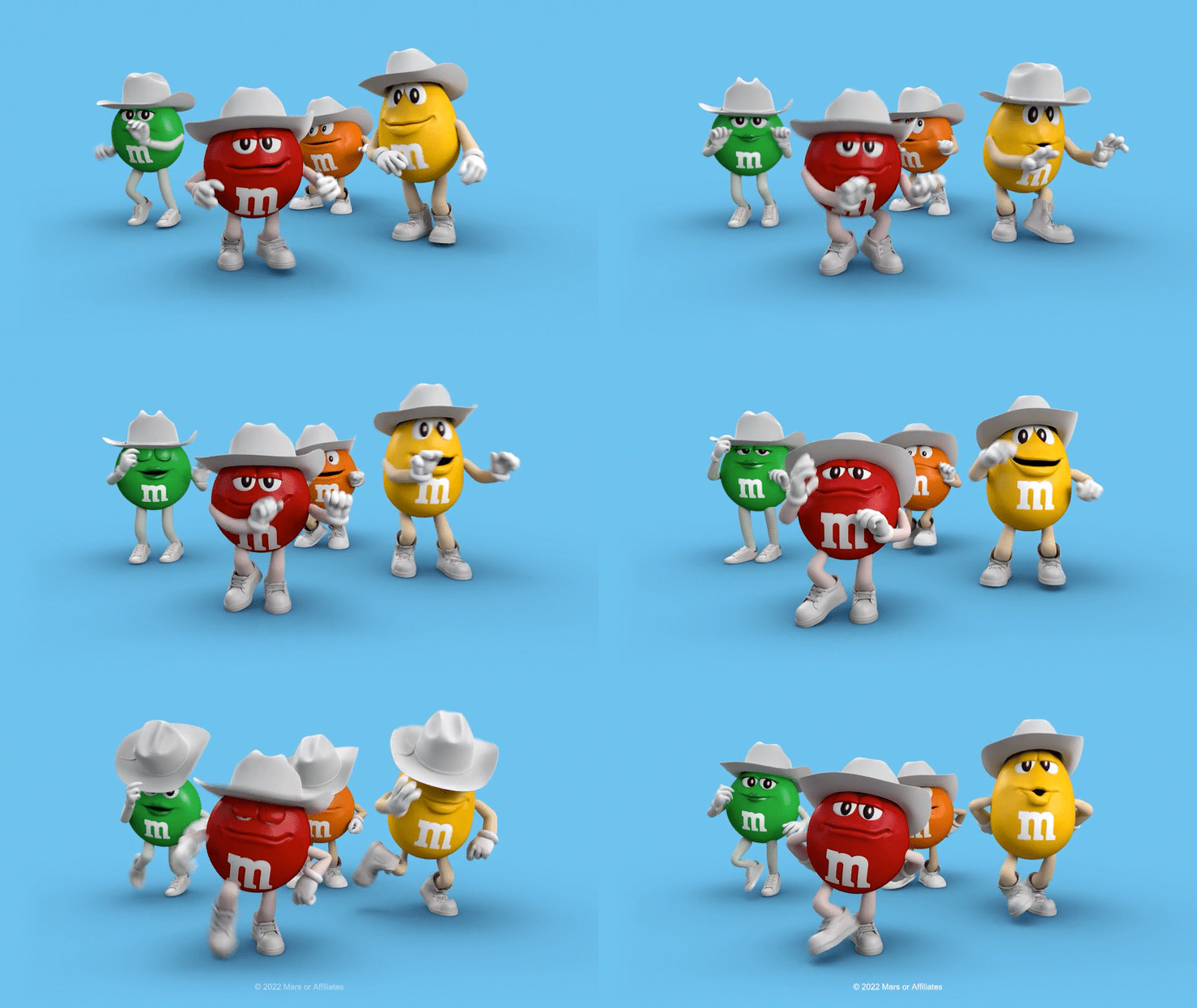
9. M&M's Characters
Character: An ensemble cast of personified candies
Created: 1954 (modern versions from 1995)
Why It Works
M&M's took a unique approach: instead of one mascot, they created an entire cast. Red is sarcastic, Yellow is naive, Green is confident, Blue is cool. Each character has a distinct personality, which means the brand can tell stories, create dynamics, and keep content fresh without ever feeling repetitive.
The ensemble approach also means there's a character for every audience to connect with. It's the same strategy that makes sitcoms work — different personalities create natural conflict and humor that a single character can't sustain alone.
The Data
- M&M's generates $2 billion+ in annual sales7
- One campaign generated 886.7 million impressions in 30 days
- M&M's characters are regular Super Bowl advertisers, among the most-watched ads each year
- The brand operates flagship M&M's World retail stores in Las Vegas, New York, London, and Shanghai
The Lesson
An ensemble cast keeps a brand fresh for decades. When each character has a distinct personality, you can tell infinite stories without exhausting a single character's appeal.

10. Energizer Bunny
Character: A pink toy bunny with sunglasses and a drum
Created: 1989
Why It Works
The Energizer Bunny is a masterclass in mascot-as-metaphor. The entire character is the product benefit: it keeps going and going and going. Every appearance reinforces the core value proposition — Energizer batteries last longer than the competition.
The phrase "keeps going and going" has entered everyday language as an idiom for persistence and endurance. When your mascot becomes a cultural reference point beyond your product, you've achieved the ultimate brand goal.
The Data
- 95% consumer recognition in the US6
- The Bunny has appeared in 115+ television commercials
- "Keeps going and going" became a cultural idiom used outside of advertising
- Energizer maintains strong market position in the battery category partly due to mascot-driven brand recall
The Lesson
The best mascots embody the product benefit, not just the brand identity. When your character is your value proposition, every appearance is a selling point.
Which brand mascots are biggest on social media?
Duolingo's Duo is the clear leader. Duolingo built a chaotic, personality-forward presence on TikTok and reports 20M+ social followers and a 41% revenue increase tied to its mascot-driven strategy.3 The owl's "Death of Duo" campaign alone generated 1.7 billion impressions.2
Mailchimp's Freddie and the M&M's characters also punch above their weight — Freddie as a social-native SaaS mascot, and the M&M's ensemble through its perennial Super Bowl ad moments. For the repeatable playbook behind this, see Animated Mascots for Social Media and our deep dive on The Duolingo Effect.
Brand mascots that powered marketing campaigns
The strongest brand mascots aren't just logos with faces — they anchor campaigns that drive measurable business results. Here are four of the most effective:
Brand Mascots That Powered Marketing Campaigns
| Mascot | Campaign | Result |
|---|---|---|
| Duolingo's Duo | "Death of Duo" | 1.7B social impressions and 169K brand mentions in two weeks2 |
| Mailchimp's Freddie | First-send high-five | Became one of the most recognized product moments in SaaS9 |
| GEICO Gecko | 25+ years of TV spots | Helped grow GEICO to the 3rd-largest US auto insurer (~12% share)12 |
| M&M's characters | Super Bowl ensemble ads | 886.7M impressions in a single 30-day campaign |
Patterns Across the Best Brand Mascots
Looking at all 10 examples, clear patterns emerge:
Patterns Across the Best Brand Mascots
| Pattern | Examples | Why It Matters |
|---|---|---|
| Simple design | Snoo, Tony the Tiger, Energizer Bunny | Recognizable at any size, easy to adapt |
| Strong personality | Duo, Wumpus, GEICO Gecko | Creates emotional connection and shareable content |
| Strategic placement | Freddie (send moment), Wumpus (empty states) | Turns functional moments into emotional ones |
| Community adaptability | Octocat, Snoo, M&M's Characters | Users make the mascot their own |
| Animated, not static | Duo, Freddie, Wumpus | Movement brings personality to life |
| Present everywhere | Duo, Tony the Tiger, Energizer Bunny | Consistency across all touchpoints builds recall |
Create Your Own Brand Mascot
Every app on this list was once a new product without a mascot. Discord didn't launch with Wumpus. Duolingo's Duo started as a simple placeholder icon. GitHub's Octocat began as a stock illustration.
The difference between then and now: creating an animated mascot used to take weeks and thousands of dollars. Today, AI animation generators can produce a custom animated character in under 10 minutes — no need to stitch together five different AI tools.
With Ziggle, you describe your ideal mascot in a text prompt and get a fully animated character with transparent backgrounds, ready to export for your app. No design skills. No animation experience. Starting at $20/month. Weighing your options? Our guide to the best AI mascot generators breaks down static-image tools versus animated ones. If you're building a mascot for a SaaS product or a mascot for an app, those guides cover the specifics for your use case.
Your brand deserves a mascot. The best time to create one was at launch. The second best time is now. If you want the full playbook, here's the step-by-step guide.